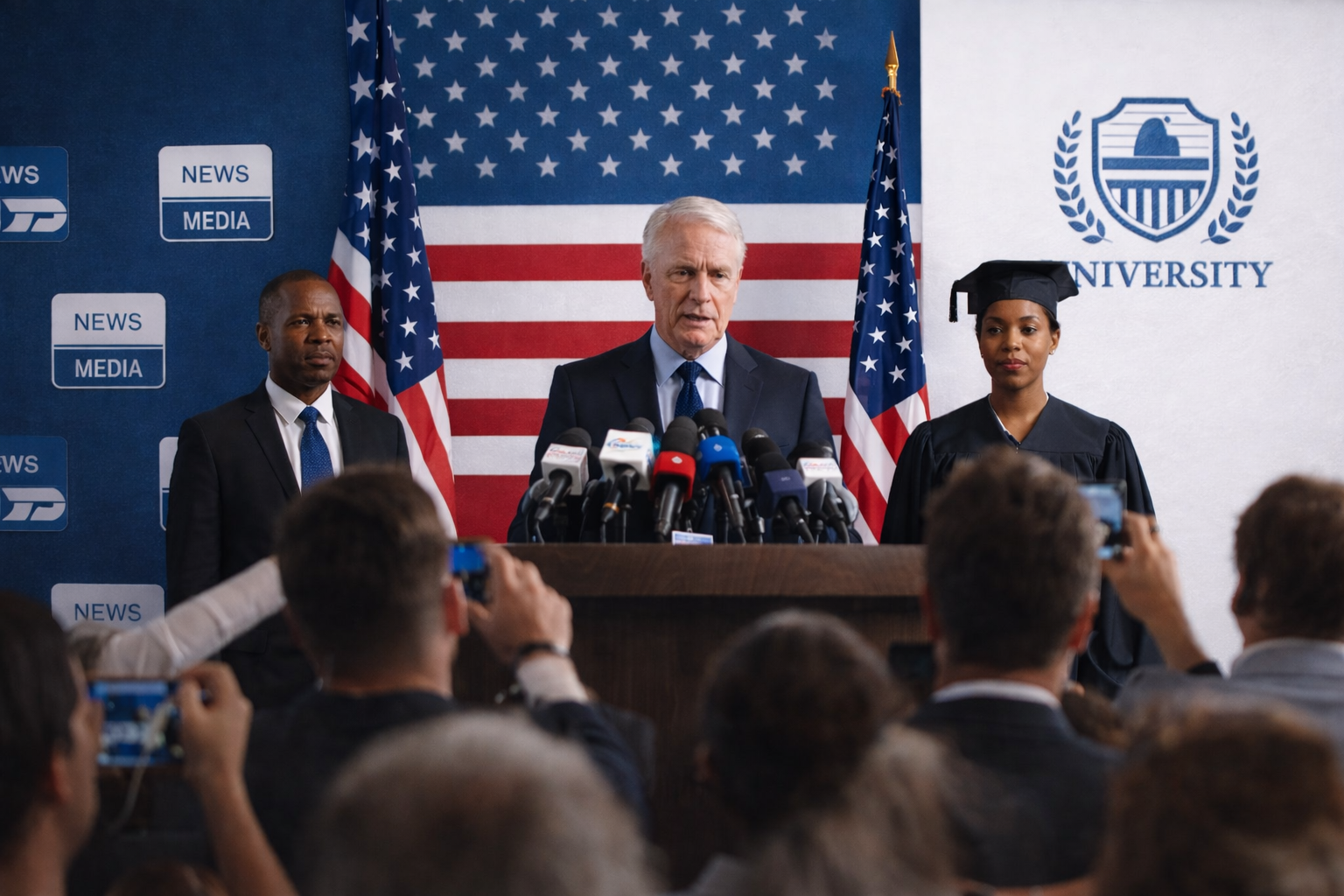
Backdrop displays are no longer limited to trade shows. Today, they are a critical visual tool for media events, press conferences, academic institutions, political organizations, and public-facing ceremonies where brand presence, credibility, and visual consistency matter.
From televised press briefings to university graduations and red-carpet photo calls, professional backdrop displays create a clean, repeatable background that reinforces identity, messaging, and professionalism. Organizations that appear frequently in front of cameras or audiences rely on high-quality backdrops to control their visual narrative and ensure consistent exposure.
This guide explores how backdrop displays are used outside traditional exhibitions and why institutions across education, government, sports, and media increasingly depend on them.
What Are Backdrop Displays?
Backdrop displays are portable or semi-permanent background systems designed to support printed graphics, logos, or messages. They are typically placed behind speakers, interviewees, or event focal points to provide a controlled visual environment.
Unlike decorative backgrounds, professional backdrop displays are engineered for:
They are commonly built using aluminum frames, tension fabric graphics, or modular panel systems, allowing them to scale from small press rooms to large auditoriums.
Media Events and Press Conferences
One of the most common uses for backdrop displays is in media and press environments. Journalists, broadcasters, and photographers rely heavily on visual context, and a professional backdrop ensures that every image captured reinforces the organization’s identity.
Backdrop displays are widely used in:
Press conferences
Media briefings
Corporate announcements
Crisis communications
Interview backdrops
For television and online media, a clean branded backdrop eliminates visual distractions and prevents unwanted background elements from appearing on camera. This is especially important for organizations that regularly appear in national or international media.
Political and Government Use Cases
Political parties, government agencies, and public institutions frequently use backdrop displays during official announcements, speeches, and public events.
These backdrops help convey authority, legitimacy, and transparency while maintaining strict visual standards. Common applications include:
Backdrop displays allow political organizations to maintain consistent messaging across different locations while remaining portable and cost-effective.
Universities, Colleges, and Educational Institutions
Educational institutions are among the most frequent non-commercial users of backdrop displays. Universities, colleges, and high schools rely on backdrops to elevate their public events and official communications.
Typical uses include:
Branded backdrops reinforce institutional identity while creating a polished environment suitable for photography, livestreams, and press coverage.
Sports Teams and Athletic Organizations
Sports teams and athletic departments use backdrop displays extensively for post-game interviews, press conferences, and sponsor exposure.
Backdrop displays are ideal for:
Because these environments require fast setup and frequent graphic changes, portable backdrop systems offer flexibility without sacrificing professional appearance.
Red Carpet Events and Photo Backdrops
Red carpet events rely heavily on visual repetition. Every photo taken becomes an opportunity for brand exposure, making backdrop displays essential.
These backdrops are commonly used for:
Award ceremonies
Film premieres
Fundraisers
Charity galas
Corporate celebrations
Step-and-repeat style backdrops ensure logos appear consistently in photographs shared across news outlets and social media platforms.
Why Institutions Choose Professional Backdrops Over DIY Solutions
Many organizations initially consider DIY banners or printed walls but quickly discover their limitations. Professional backdrop displays offer clear advantages:
Wrinkle-free graphics for photography
Structural stability
Consistent alignment and sizing
Professional materials suitable for repeated use
Clean edges and finishes
For institutions that value credibility and public perception, professional backdrops are an investment in visual trust.
Portability and Reusability for Multi-Location Events
One of the key reasons institutions prefer modular backdrop displays is portability. Educational systems, political organizations, and sports leagues often operate across multiple locations.
Backdrop displays can be:
Packed into compact cases
Transported easily
Reassembled without tools
Reused with updated graphics
This makes them ideal for touring events, rotating campuses, or traveling press teams.
Choosing the Right Backdrop Display for Institutional Use
When selecting a backdrop display, institutions should consider:
Fabric tension systems are popular for media use due to their seamless appearance, while modular panel systems are often preferred for larger institutional environments.
Backdrop Displays as a Long-Term Communication Asset
Backdrop displays are not one-time event materials. For many organizations, they become a permanent part of their communication toolkit.
A single system can support:
Press events
Internal communications
External branding
Media outreach
Archival photography
This long-term value makes backdrop displays especially appealing to institutions operating under budget constraints while maintaining high public standards.
Final Thoughts
Backdrop displays play a critical role far beyond trade shows. They are essential tools for institutions that communicate publicly, appear in media, or host formal events.
Universities, political organizations, sports teams, and media professionals rely on backdrop displays to control visual presentation, reinforce identity, and project professionalism across every appearance.
As public communication becomes increasingly visual and digital, the importance of high-quality backdrop displays continues to grow.